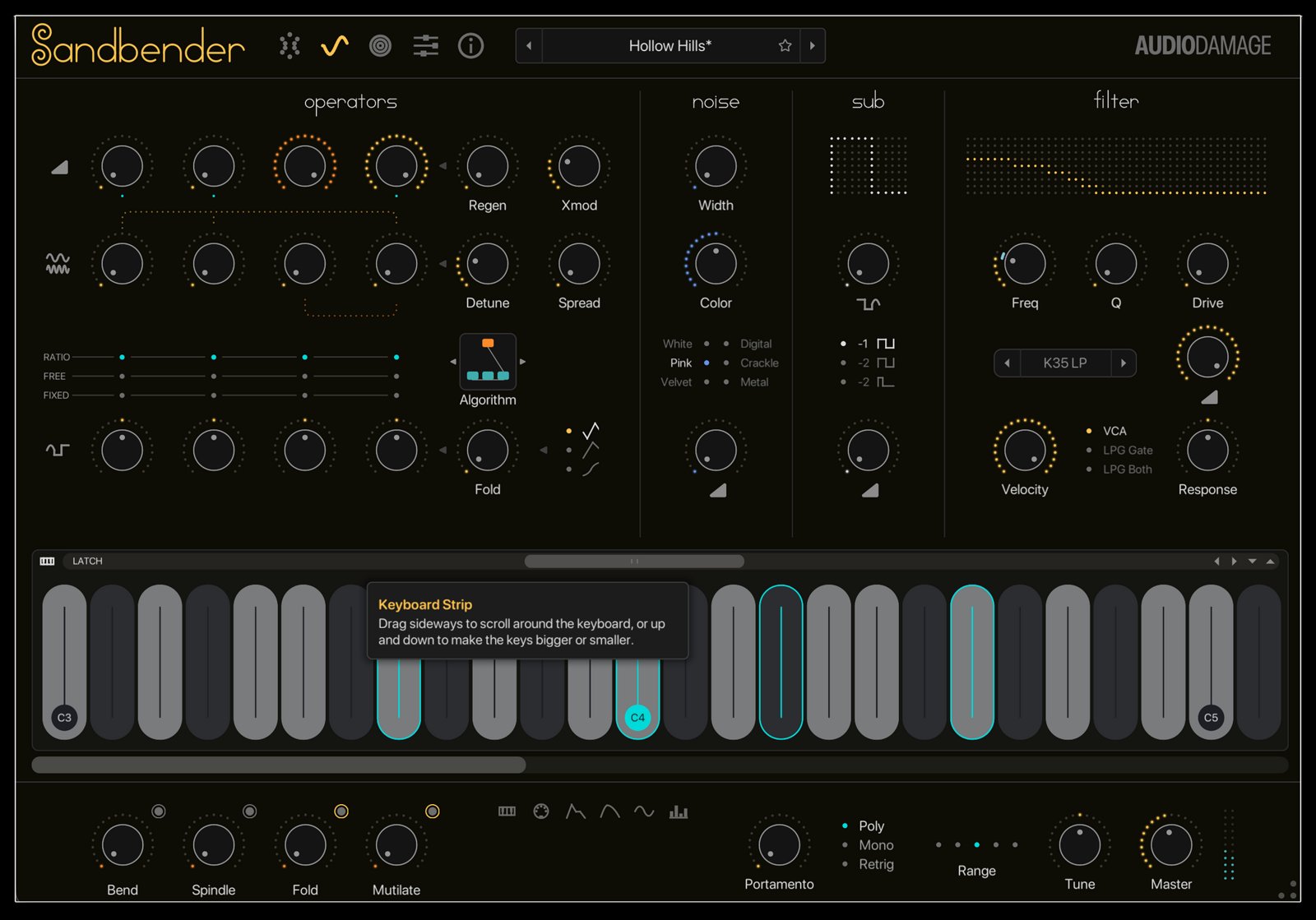
Audio Damage has released Sandbender, an eight-voice, four-operator FM synthesizer for macOS, Windows, Linux and iOS. The four operators are only the starting point: each one has its own wave shaper, and they sit alongside a wavefolder, a sub oscillator, six noise types, an eleven-mode filter and a modeled low pass gate.
Audio Damage built it to take the chore out of FM programming. As the developer puts it: "If all you want is a nice FM bell, I'm happy to report that Sandbender makes a very nice FM bell. It just seems a shame to stop there."
Audio Damage Sandbender FM engine
There are ten factory algorithms plus an algorithm designer for drawing your own, and any operator can sound and modulate at the same time. Each operator tunes by harmonic ratio, free ratio or fixed frequency. Xmod, Regen, Detune, Spread and a 32' to 2' Range control work across the whole stack.
- Warp: a one-knob shaper on every operator morphs its wave from triangle through sine to pulse
- Fold: a symmetric, asymmetric or soft-clip wavefolder that adds harmonics without rearranging the sidebands
- Sub oscillator: a divider clocked by operator 1, one or two octaves down or a two-octave pulse, with its own Warp
- Noise: White, Pink, Velvet, Digital, Crackle and Metal, each with Color and stereo Width
Filter, low pass gate and voices
The eleven filter types cover state-variable, ladder, diode and Sallen-Key designs in low pass, high pass and band pass, with resonance and Drive, in stereo in every voice. Each voice ends in a plain VCA or the low pass gate, driven by the amp envelope. One gate mode stays close to clean; the other ties brightness to loudness for plucks and woody decays, and velocity closes either one.
Sandbender plays in poly, mono or retriggered mono with portamento, and adds an output limiter and 1x to 8x oversampling.
Modulation, GENETICS and PERFORM
Modulation is drag-and-drop: pull a source off the modulation rail onto a knob and set a bipolar depth. Per voice there are two ADSR envelopes with curve controls, two LFOs with host sync, delay and retrigger, and two function generators that rise and fall on a trigger, cycle as LFOs or slew any source. A 16-step sequencer runs in every voice, restarting per note or running free. Four renameable macros, velocity, key tracking, mod wheel, pressure, pitch bend and five assignable MIDI CCs round out the sources, alongside full MPE and MTS-ESP microtuning.
GENETICS, the patch generator that first appeared in Audio Damage's Continua 1.2, breeds a family tree of variants from the current sound. Choose which parts may change, click a node to hear it and double-click to breed from it. PERFORM gives you two nodes on a full-page touch surface, each axis aimed at a macro, synth control, the filter or an effect mix, plus a tempo-synced gesture recorder of 1 to 8 bars that saves with the preset.
Effects and presets
Six Audio Damage effects sit at the end of the chain in any order, each with its own mix: Evil Otto multiband compression, Dubstation delay, ADverb, Quatromod's flanger, chorus, diffusor and frequency shifter, Kombinat's thirteen distortions and the Phasetwo dual phaser. More than 260 factory presets are spread across nine categories, from Vintage FM and Keys to Dubstep, MPE and FX.
Audio Damage Sandbender price and formats
Sandbender is available now for $99 on desktop, with a perpetual licence and no DRM, subscriptions or dongles. Formats are CLAP, VST3, AU and AAX on macOS 10.15+ (Intel or Apple Silicon), CLAP, VST3 and AAX on Windows 10+, and CLAP and VST3 on Linux (Ubuntu 22+). The AUv3 version for iPhone and iPad (iOS 16+) costs $6.99 on the App Store. The desktop demo runs with a 20-minute session timer and saving disabled.
More information: audiodamage.com
Image in this article is from Audio Damage.