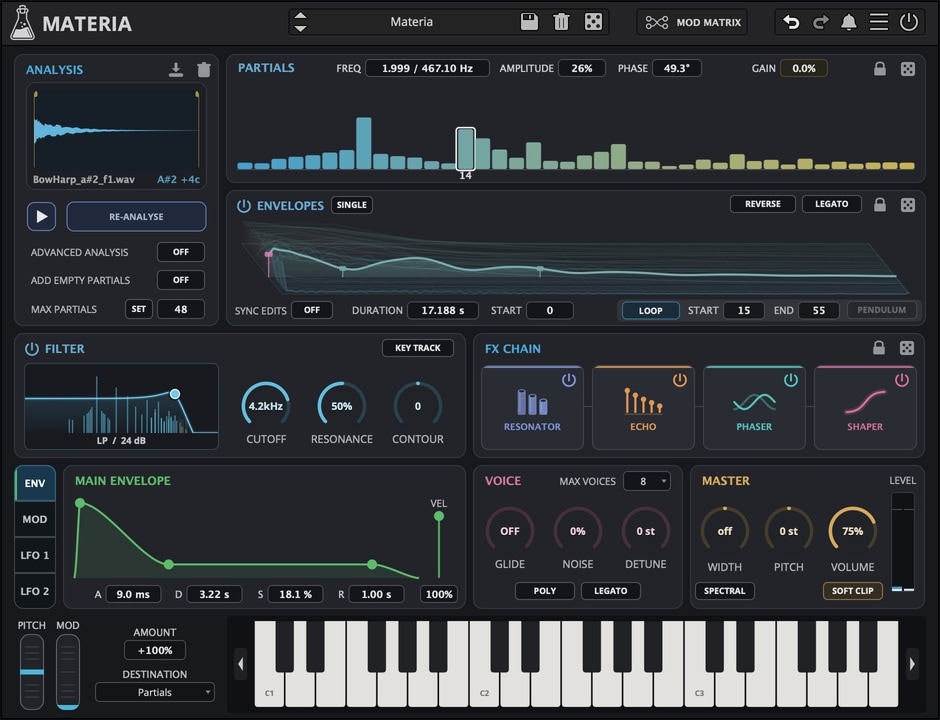
AudioThing has released Materia, a new additive re-synthesizer that turns any sample into a playable instrument. Drop in a sound and Materia breaks it down into harmonic partials, each with its own frequency, amplitude, phase, and envelope, so you can rebuild it, reshape it, or push it somewhere completely new.
It's out now for macOS, Windows, and Linux in VST2, VST3, AU, AAX, and CLAP formats, at an introductory price of $39 (regular price $69) until October 31, 2026.
From sample to spectrum
The workflow starts in the sample panel. Load a recording, and Materia analyses it into up to 96 partials. That partial spectrum is the heart of the instrument: select any partial to change its frequency ratio, amplitude, or phase, or use the global partial controls to rebalance the whole sound.
Each partial gets its own 128-point envelope with editable duration and sustain loop points, so you can redraw how individual harmonics start, sustain, and fade. A Sync Partial Edits option applies the same timing to every partial at once, while Advanced Analysis gives each partial independent envelopes and sustain loops. You can also add empty partials and draw in new harmonics by hand, or skip the sample entirely and build a sound from a blank spectrum.
One handy detail: the analysed model is saved with the plugin state, so a project or preset reopens without needing the original sample file.
Resonator, filter, and effects
After the additive engine, Materia adds a filter with 10 types, including low-pass, high-pass, band-pass, notch, and formant modes, plus a four-slot effects chain.
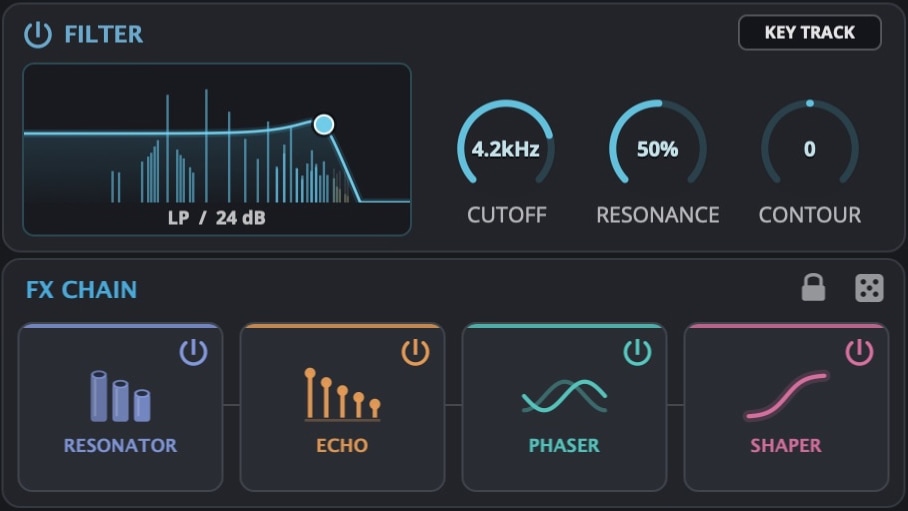
The standout effect is an algorithmic resonator that models physical materials such as pipes, plates, glass, wood, stone, gongs, membranes, and springs, which fits the plugin's name nicely. It's joined by a tap echo, a multi-stage phaser, and a waveshaper.
Other features include:
- 2 envelopes and 2 LFOs with fully drawable waveforms for modulation.
- Polyphonic playback of the re-synthesized sound.
- A preset browser with randomizer.
- A resizable window with brightness and contrast controls.
Pricing, demo, and system requirements
Materia costs $39 during the intro offer, then $69. A license covers up to three computers, and activation works online or offline with no iLok required. It runs on Windows 7 to 11, macOS 10.13 to macOS 26 (Universal 2 binary for Apple Silicon and Intel), and Ubuntu 20.04 or newer. An iPad version has not been released yet.
You can try it first with a free demo, which inserts three seconds of silence every 45 seconds and disables saving. For sound designers who like spectral tools, it's an affordable way to turn field recordings, vocals, or one-shots into evolving, playable textures. Details and the demo are on AudioThing's Materia product page.
Images in this article are from AudioThing.