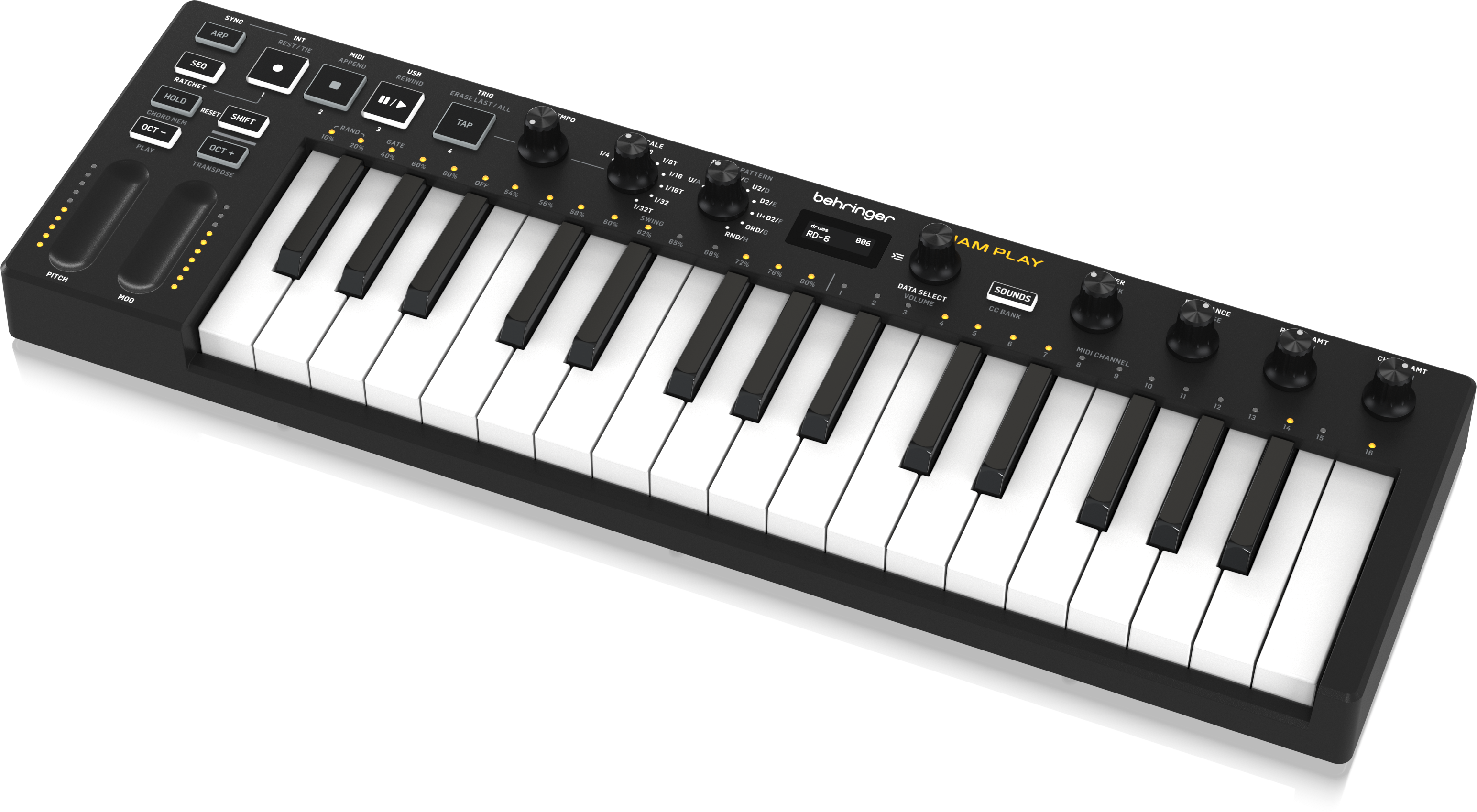
Behringer has a new pair of portable keyboards aimed at sketching ideas anywhere. Jam and Jam Play are compact 32-key USB MIDI controllers built around a surprisingly deep polyphonic step sequencer, and the Play model adds onboard sounds so you can write without a computer at all.
Both are now listed at retailers. Thomann prices Jam at $92 / €98 and Jam Play at $168 / €179.
Jam: a controller built around the sequencer
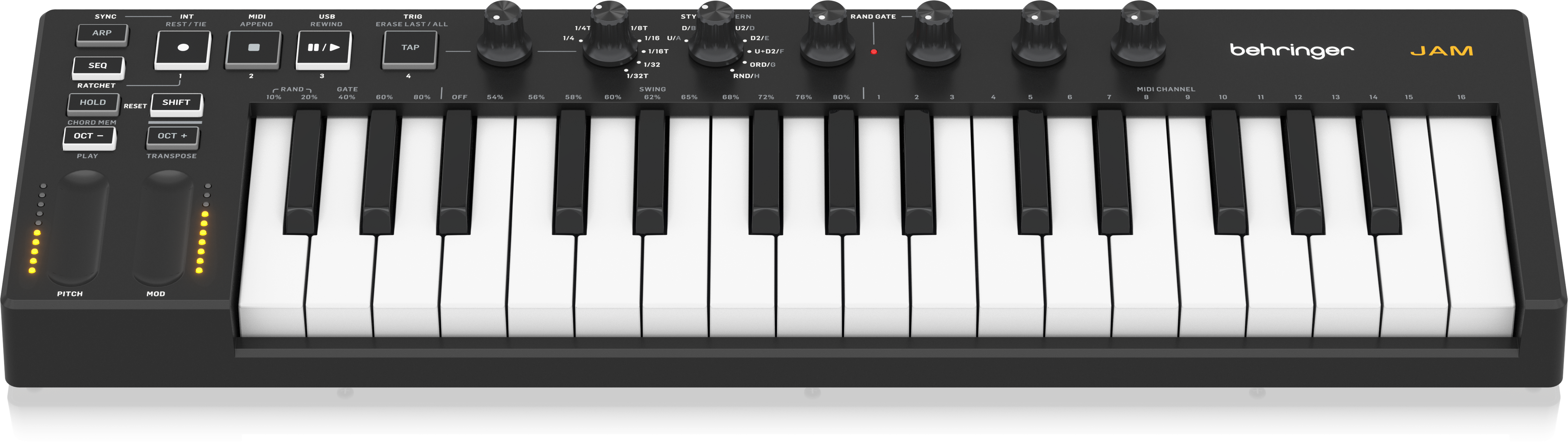
On paper, Jam looks like a simple mini-key controller, but its real focus is sequencing. The 32 compact keys are velocity- and aftertouch-sensitive, which is unusual at this price, and pitch and modulation are handled by two touch strips on the left side.
The 64-step sequencer handles up to eight notes of polyphony, with rest, tie, and legato note entry, plus ratchets and random gate for adding movement to loops. There's also a Chord Play mode that stacks voicings of up to 16 notes, and an arpeggiator that runs up to eight notes per step across eight styles, from classic up-down patterns to random sequences.
Four assignable knobs cover your DAW or hardware parameters, and dedicated Record, Play, and Stop buttons keep the sequencer and arpeggiator under your fingers.
Hooks into hardware and modular rigs
Jam isn't just for computers. Behringer gives it CV/Gate and sync connectors for driving synthesizers, drum machines, and modular systems, with four sync sources selectable from the front panel. Class-compliant USB, a MIDI Out port, and a sustain pedal input cover the rest, and it runs on USB bus power or an optional DC supply.
Jam Play adds sounds, an OLED, and four sequencer tracks
Jam Play keeps the same keybed, touch strips, chord mode, and arpeggiator, then turns the controller into a small standalone songwriting box:
- 128 instrument voices and 10 drum kits with effects, played through a headphone output, so no laptop or DAW is required.
- A 4-channel, 64-step sequencer with eight-note polyphony, enough to layer drums, bass, chords, and a melody.
- A multi-function OLED display for navigating sounds and settings.
- Shift functions for MIDI channel, gate time, and swing, plus endless sustain via a hold button or optional footswitch.
- The same CV/Gate, sync, USB, and MIDI Out connections as Jam, with USB power.
Jam Play doesn't have a dedicated line output, so the headphone jack is the way to hear its onboard sounds.
Who it's for
With aftertouch keys, a polyphonic sequencer, and CV/Gate in a backpack-sized controller, Jam looks like a budget way to sequence a hardware or modular setup, while Jam Play is aimed at producers who want to sketch full ideas on the couch or on the road before moving to the studio.
Full specs are on Behringer's Jam product page and Jam Play product page.
Images in this article are from Behringer.