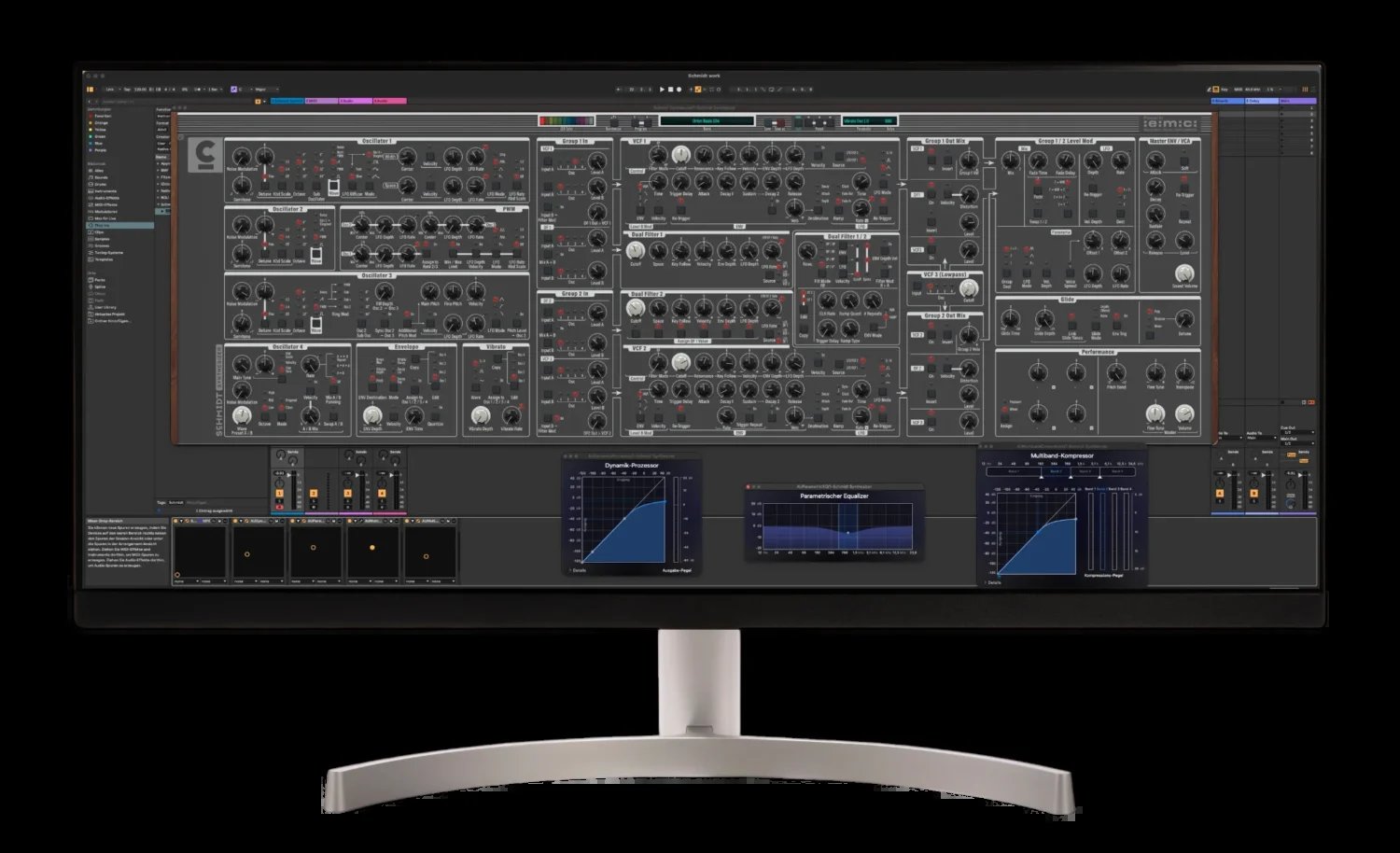
Schmidt Synthesizer has released Schmidt Vi: an emulation of the Schmidt Eightvoice analog polysynth, developed with UJAM. The team analysed and modelled the hardware's analog signal path to reproduce its circuit behaviour and the interactions between its sections. It runs as a VST, VST3, AU and AAX plugin on macOS and Windows, and costs €179 at launch.
The Eightvoice debuted at Musikmesse Frankfurt in 2012: a large-format, eight-voice analog polysynth built in Germany with through-hole construction for long-term repairability, and a no-expense-spared flagship from the start. Schmidt, based in Langenau and "powered by e:m:c (electronic music components)", showed an early prototype of the plugin at Superbooth in May 2026.
Hardware production is ending. Once the remaining Classic units and The Final Series, a last run of 20 units, are sold, the Eightvoice is discontinued. Schmidt cites rising manufacturing costs and technological developments.
Schmidt Eightvoice emulation: voice architecture
Schmidt Vi plays in polyphonic, mono and unison modes. Each voice runs through two separate signal paths, Group 1 and Group 2, which can be recombined and placed freely in the stereo field. An LFO can move sounds across the panorama.
Schmidt Eightvoice emulation: oscillators
There are four audio oscillators per voice, each with a different character:
- Sub-oscillators on VCO 1 and VCO 2
- Multiple pulse-width modulations, plus FM, sync and ring modulation
- Oscillator 4 builds complex waveforms, called wavepresets, from multiple ring modulations, and can morph from one waveform to another once or continuously via an LFO
Schmidt Eightvoice emulation: filters
Each voice carries seven filters:
- VCF 1 and VCF 2: two Moog-type multimode filters that sweep continuously from low pass through band pass to high pass
- Dual Filter 1 and 2: two Oberheim-type dual filters with adjustable spacing, in HP/HP, BP/BP, LP/HP and LP/LP configurations
- VCF 3: a small 12 dB low-pass filter at the end of the chain that works as an "afterburner"
The multimode and dual filters take filter FM and run in parallel or series, with the balance continuously adjustable between the two.
Schmidt Eightvoice emulation: envelopes, VCA and modulation
The VCA at the end of the path has an envelope with a loopable ADS section, which turns a single held note into sequencer- and arpeggio-like patterns. A Trigger Delay function in the filters and an extra VCA envelope parameter create delay- and reverb-like effects inside the voice.
Modulation comes from 16 LFOs and 9 envelopes, each placed at the relevant point in the signal path. There's no modulation matrix: the modulation controls sit in each section, as they do on the hardware panel.
Schmidt Eightvoice emulation: features beyond the hardware
- Knob positions show actual values
- A randomizer for generating new patches
- Pitch wheel and aftertouch routable to multiple destinations
- MPE support and MIDI Learn
- Polyphony beyond the hardware's eight voices
- Hardware owners can control the plugin from the Eightvoice's front panel
The hardware's multimode (multitimbral) feature is left out, since you can simply run multiple instances. All original Eightvoice factory presets are included, sorted by category.
Schmidt Eightvoice emulation: price and availability
Schmidt Vi is available now for €179 including tax, an introductory price before it rises to €199. It's sold through the Schmidt Synthesizer shop and the Waldorf Music online shop. Formats are 64-bit VST, VST3, AU and AAX for macOS and Windows. Copy protection is iLok, which needs a free iLok account and the iLok License Manager.
Schmidt Eightvoice emulation: who it’s for
The Eightvoice was always a rare, costly instrument, and with The Final Series it's about to stop being made at all. Schmidt Vi keeps its four-oscillator, seven-filter voice and section-by-section modulation in production as software, at a fraction of the hardware's price. For sound designers who never got near one, it opens up a deep analog architecture; for owners, the front-panel control and extra polyphony make the plugin a companion to the hardware.
More information: shop.schmidt-synthesizer.com
Image in this article is from Schmidt Synthesizer.