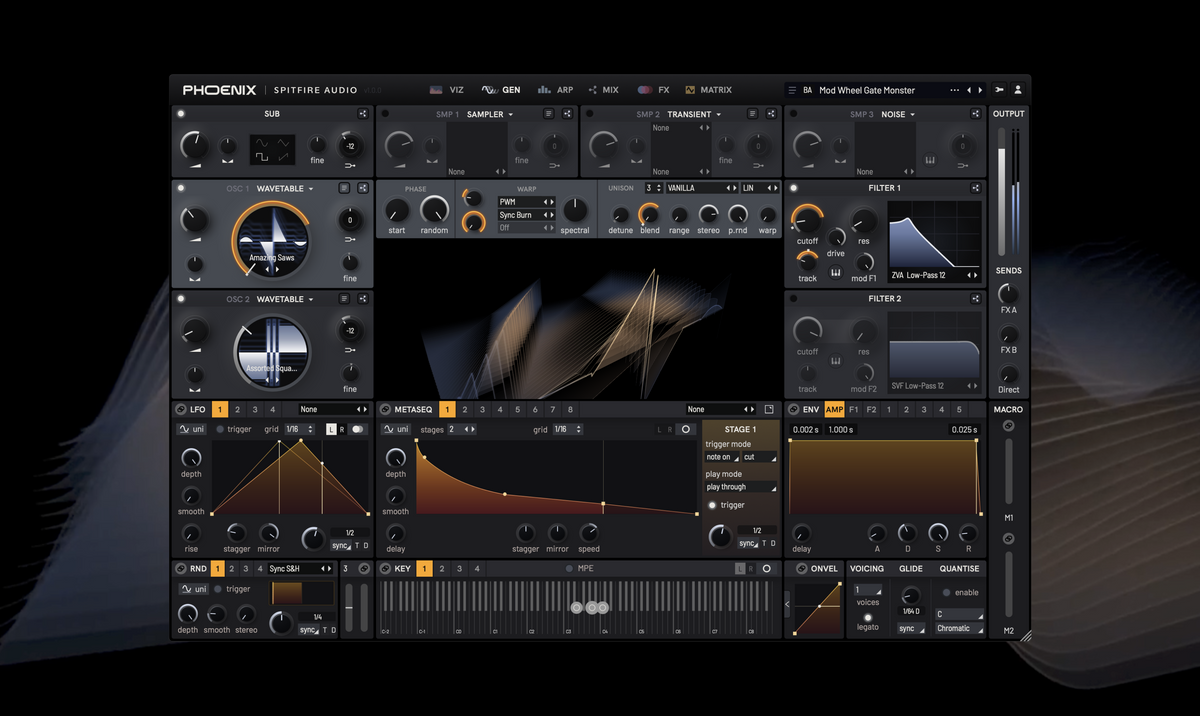
Spitfire Audio has released Phoenix, a deep hybrid synthesizer made with Grammy-nominated composer, producer, and technologist BT. It's the third Spitfire and BT instrument, following Phobos (2017) and Polaris (2022), and it's aimed squarely at scoring and cinematic sound design.
Phoenix runs standalone or as a VST3, AU, or AAX plug-in. It's available now from the Phoenix product page at an introductory price of £199 until 25 October 2026, after which it goes to £249.
Six engines inside every note
Rather than switching between synthesis types, Phoenix runs up to six engines together in one shared signal path:
- Spectral wavetables
- FM, with six operators and 34 algorithms
- Sampler
- 2-operator FM transients
- Subharmonic generation
- A complex noise oscillator
The engines can modulate each other, and Spitfire says a single note can stack up to 48 oscillators. Any sample can also be used as an FM operator.
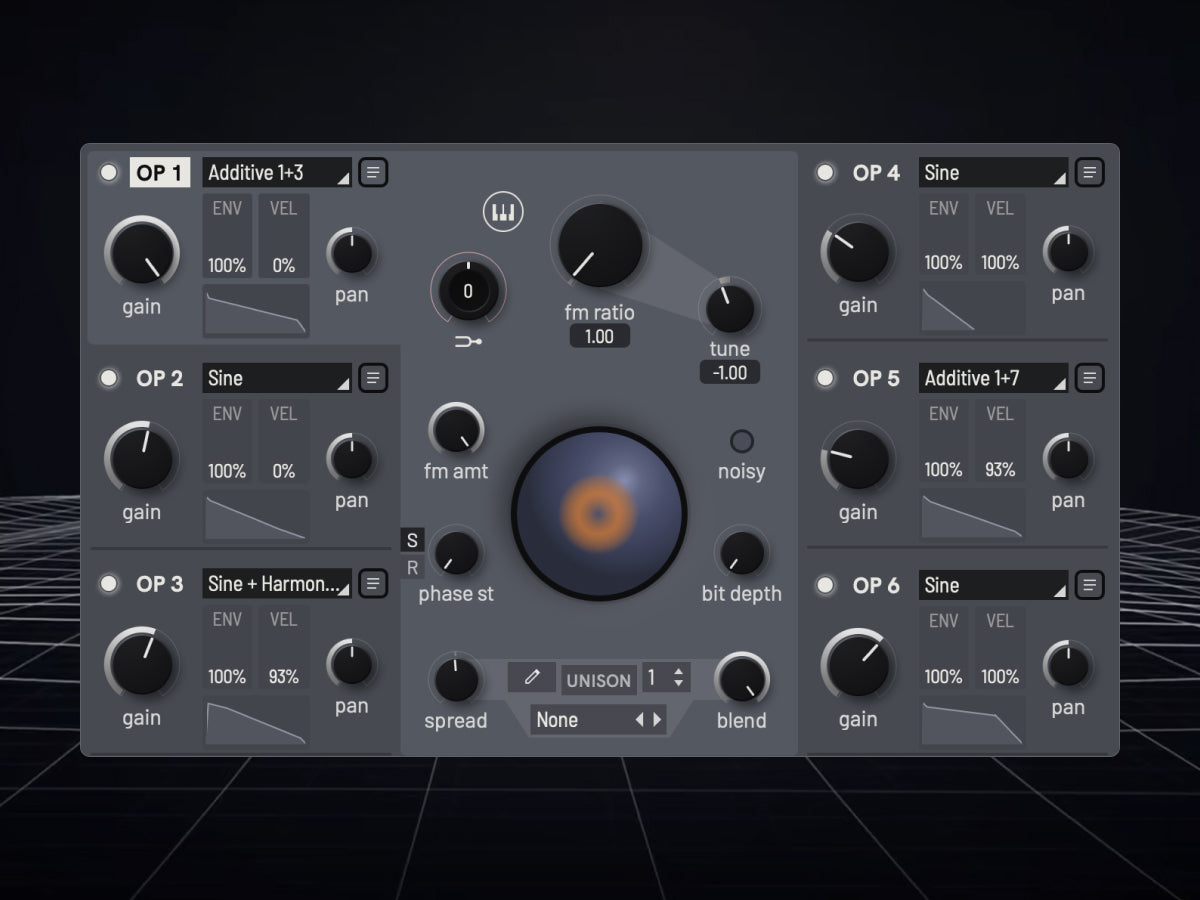
Phoenix is stereo from the ground up. The left and right channels run independent synthesis chains, so one held note can play two slightly different instruments, with different wavetable positions and warps drifting apart in real time. The phase-warp section has more than 80 warp modes across two serial slots, and warp depth can be modulated per channel.
A 40GB sampler of BT and Spitfire recordings
The sampler is loaded with about 40GB of recordings. Spitfire combined material from BT's archive of vintage synthesizer, sampler, cassette, and vinyl sounds with orchestral recordings from its own libraries. That includes granular strings, brass in quarter-tone clusters, woodwinds, guitars, dulcimer, cimbalom, autoharp, hand bells, and music box, plus hits and atonal textures.
Sequencers, StutterEdit-style modulation, and 37 effects
Modulation draws on the rhythmic ideas behind BT's patented StutterEdit technique. Phoenix includes eight sequencers that double as envelopes, with drawable stages that can loop, palindrome, or run backwards mid-note. A separate meta sequencer has four stages of 128 steps, per-stage play probability, eight scale modes, and a seeded random generator, so a random take you like can be reproduced exactly.
The effects section has 37 processors, each with its own interface, spread across 12 slots in three chains. They range from spectral smearing to granular reverbs.
Phoenix ships with 552 presets and supports full MPE with up to 16 voices of stereo polyphony. Spitfire notes that the available voice count depends on patch complexity and your computer.
System requirements
Phoenix needs a reasonably powerful machine and a constant internet connection:
- macOS: macOS 15 or later, with at least an Apple M1 or a 2019 or newer 8-core Intel Core i9 and 16GB RAM. Spitfire recommends an M2 Pro, M3, or newer with 32GB RAM.
- Windows: Windows 10 (22H2) or Windows 11, 64-bit, with at least an Intel Core i7 10th Gen or AMD Ryzen 5 5000 series and 16GB RAM. Spitfire recommends a Core i7 12th Gen or Ryzen 7 5000 series or newer with 32GB RAM.
- Storage: an SSD with 80GB or more free for installation, since the 40GB library needs about twice its size to install.
- Formats: AU (macOS only), VST3, and AAX in a 64-bit host, or standalone.
Phoenix currently has to stay online while it's running. Spitfire says offline support is a top priority and is coming in a future update.
Price and availability
Phoenix is sold only through Spitfire Audio's website as a perpetual licence. The £199 introductory price, 20% off, runs until 25 October 2026, and the regular price is £249. It installs through the Spitfire Audio app. More coverage is in Sound On Sound's Phoenix news story.
Images in this article are from Spitfire Audio's Phoenix product page.