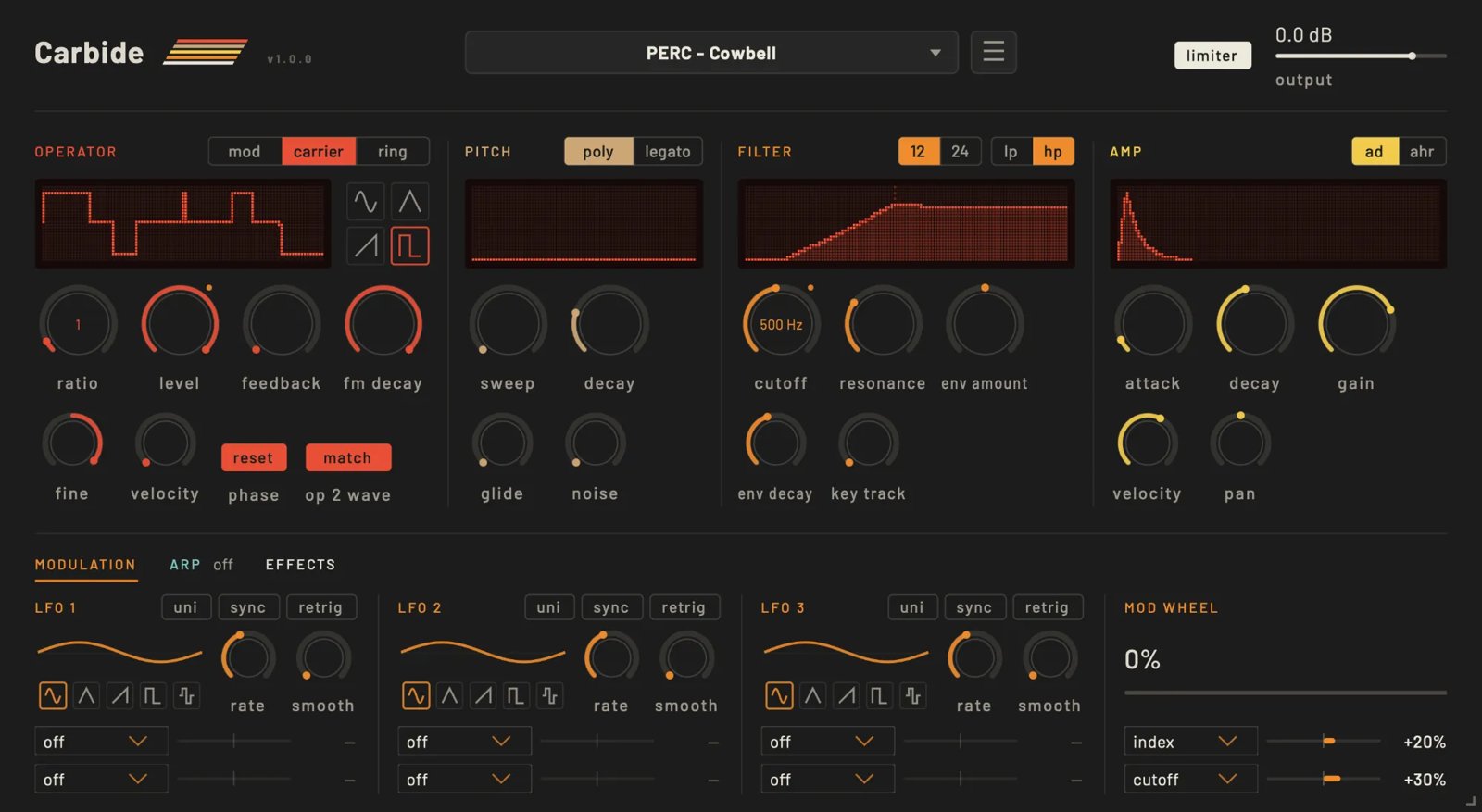
Wavefold Labs has released Carbide, a 16-voice, two-operator FM synthesizer for macOS, Windows, Linux and iPad. Launched November 25, it lays the voice out left to right in signal order (operator, pitch, filter, amp), with modulation, arp and effects tabs below. It's built for FM electric pianos and bells, slap and acid basses, tuned drums, house and techno arps, and ring-mod clangs.
Carbide FM synth operators: mod, carrier and ring modes
Pick a sine, triangle, saw or square carrier, then set operator 2's mode: mod for classic two-operator FM, carrier to run it as a second oscillator for sub-octaves and detuned pairs, or ring to multiply it with the carrier.
Ratio runs from 0.5 to 32 with fine tune, feedback bends operator 2's sine toward a saw, and FM decay stretches from a 0.1 ms click to the whole note. Match gives operator 2 the carrier's waveform for twin saws or squares in carrier mode. A dot-matrix display redraws the wave as you turn the knobs, and pitch sweep and noise shape drums and attacks.
Carbide filter and per-voice drift
The 12 dB/octave slope is an open-sounding state-variable filter with a broad peak; the 24 dB/octave transistor ladder has narrower, more vocal resonance that holds the bass as you turn it up. Both run low-pass or high-pass, and the filter envelope sweeps cutoff up to eight octaves either way.
The drift knob gives each voice its own fixed tolerances in pitch, FM ratio, waveform shape, envelope timing and filter cutoff, like parts on a real voice card, and every note adds a little variation of its own. Up to 50%, it stays within what analog hardware could produce, most audible on chords, pads and repeated notes; beyond that, Carbide turns detuned and gritty. Drift is deterministic, so its variations repeat identically on playback and in bounces.
Carbide LFOs, arpeggiator and effects
Three LFOs run free from 0.01 to 100 Hz or sync from a 1/32 note to 8 bars, each with five shapes and two destinations, and the mod wheel can fade any LFO in or out for vibrato.
The arpeggiator follows the host tempo (the standalone iPad app has its own tempo knob) and spans up to four octaves with gate, swing and latch. Under it sits a 16-step rhythm lane offering per-step gate, accent, tie, octave shift and probability. Set the lane anywhere from 1 to 16 steps for polyrhythms.
Effects include drive on the summed voices, so chords distort together, plus chorus, tempo-synced ping-pong delay, reverb and an output limiter, on by default, that holds peaks at -0.1 dBFS. All 74 factory presets map the mod wheel, and the eight color themes are editable JSON files.
Carbide FM synth price, formats and system requirements
The desktop plugin costs $40, or $28 with the intro offer through December 10, and a free Wavefold Labs account gets you a 14-day trial. On iPad, Carbide is a free standalone app with 22 factory presets and unlimited user presets; a one-time $9.99 Full Unlock in-app purchase adds the AUv3 plugin, all 74 presets and all eight themes.
- Formats: VST3 (macOS, Windows, Linux), AU (macOS), standalone and AUv3 (iPad)
- macOS: macOS 14 or later, Intel or Apple Silicon; 64-bit VST3 or AU host
- Windows: Windows 10 or later, Intel x86_64; 64-bit VST3 host
- Linux: x86_64, glibc 2.39 or later (e.g. Ubuntu 24.04+, Fedora 40+, Debian 13+, Arch); X11 session or Wayland with XWayland
- iPad: iPadOS 18.6 or later
More information: wavefoldlabs.com/products/carbide