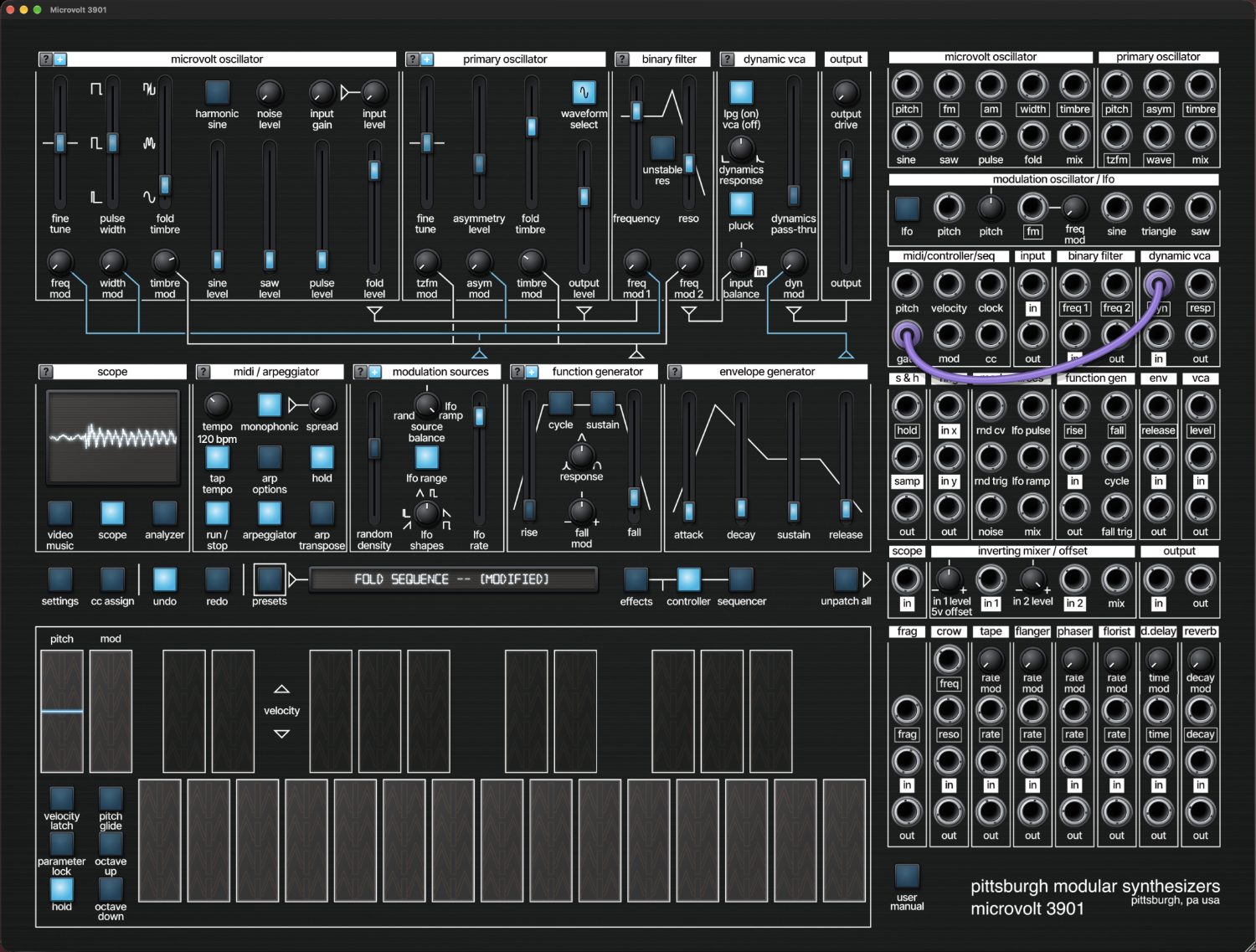
Pittsburgh Modular has released its first software instrument, Microvolt 3901, a recreation of the company's Microvolt 3900 semi-modular analog synth. Rather than licensing the job to an outside developer, Pittsburgh Modular modeled its own circuits at the component level, then expanded the design with digital versions of classic modules from its Eurorack catalog.
A small modular system, not a fixed synth
Like the hardware, the 3901 is fully patchable: virtual cables carry audio and control voltage between every module. The big difference is polyphony. The software plays with up to six voices, or monophonically with up to six unison voices, something the original mono hardware can't do.
The module list goes well beyond the 3900:
- Oscillators: the Microvolt oscillator, the Lifeforms SV-1 oscillator, the Primary Oscillator from the upcoming Voltage Lab mini, Generator, VCO 2, and two digital lo-fi oscillators, Double Helix and DNA Symbiotic Waves.
- Modulation: VILFO (the company's very first Eurorack module), Dual LFO, Function Generator, Game System, Three Stage Envelope, Envelope Generator, Modulation Oscillator, Sample & Hold, and Ring Modulator.
- 19 effects: including Fragments, Crow filter, Lo-Fi Tape, BBD and 2399 delays, Verbtronic, fuzz, overdrive, resonator, bit crush, and compressor. They can sit at the end of the chain or be patched inside the synth.
Built-in controllers and tools
- A touch-plate keyboard designed for touchscreens and the iPad, plus a deep 16-step sequencer.
- MIDI input, Ableton Link, and host sync for use with external keyboards and DAWs.
- An integrated oscilloscope and spectrum analyzer.
- 200 factory presets with import and export, and 100 steps of undo.
- A built-in manual for every module: click the question mark in a module's title bar.
Pricing and availability
Microvolt 3901 is available now for macOS (standalone, AU, and VST3; macOS 12 or later, Apple silicon or Intel) and Windows (standalone and VST3; Windows 10 or 11, including ARM64) for $69, with a 7-day free trial. An iPad version with standalone and AUv3 support is listed as coming soon at $24. Downloads and details are on the Microvolt 3901 product page.
Why it matters
Most hardware emulations are built from the outside, by measuring a unit and approximating what it sounds like. Here the people who designed the circuits did the modeling, and they used software to fix the hardware's biggest limits: one voice and no recall. At $69 it's also a cheap way to try West Coast ideas like wavefolding and low-pass gating before spending money on Eurorack.
Images in this article are from Pittsburgh Modular.